Painter, Advocate, Professor
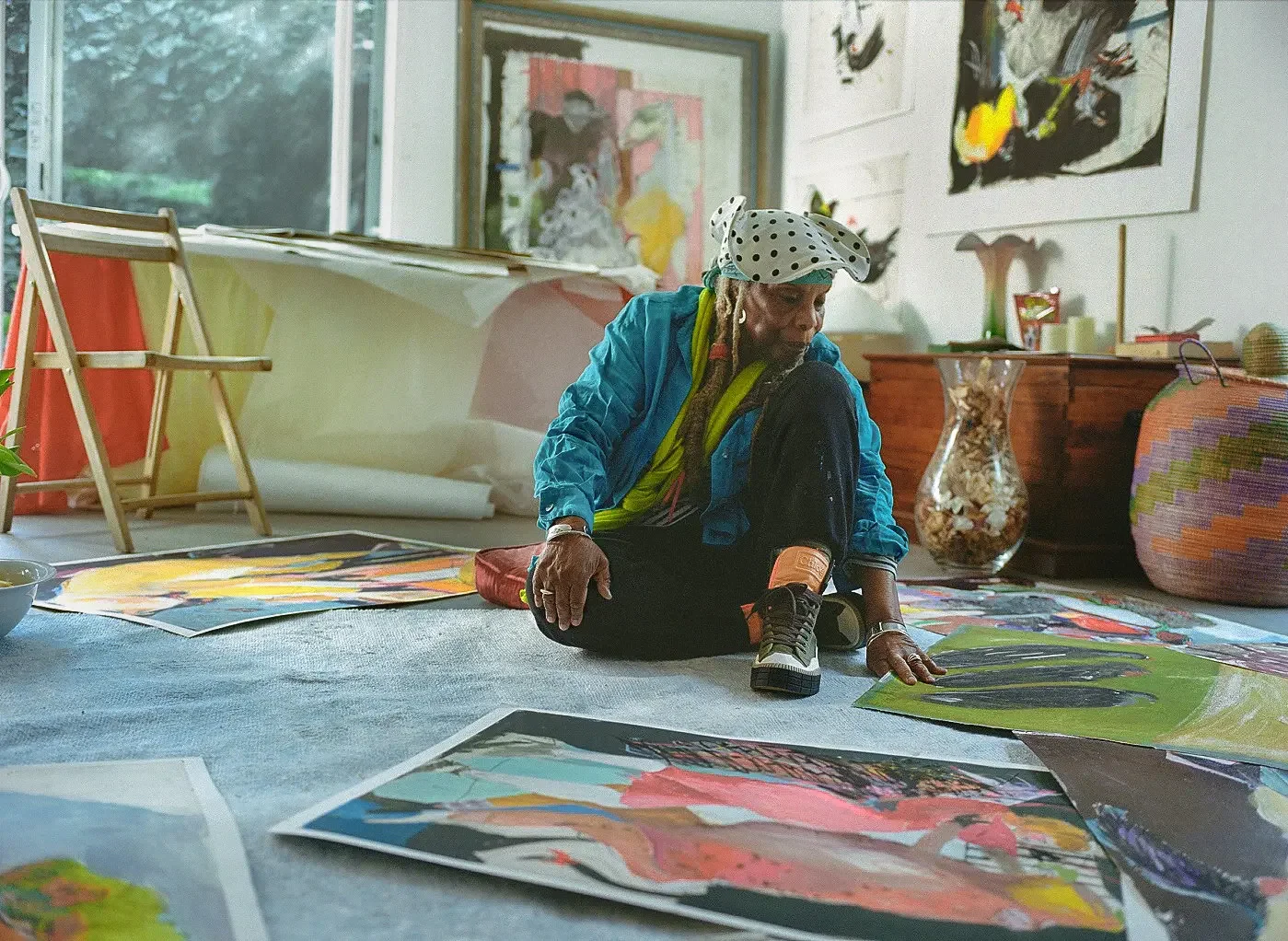
Photo Credit: Aubrey Trinnaman for The New York Times
Remembering Mary Lovelace O’Neal
February 10, 1942 - May 10, 2026
Mary Lovelace O’Neal, the acclaimed painter, professor, and social activist whose expansive, materially rich canvases reshaped contemporary abstraction over a career spanning six decades, died at age 84 on May 10, 2026.
Best known for monumental abstractions layered with soot-black surfaces, sweeping gestures, and richly textured fields of color, Lovelace O’Neal developed a visual language that defied easy categorization. Her work expanded the possibilities of postwar abstraction by insisting that formal experimentation and Black political consciousness could exist on the same canvas.
Long regarded as an “artist’s artist” within the San Francisco Bay Area, Lovelace O’Neal’s later years brought renewed institutional recognition and a broader international audience for work that had remained fiercely independent throughout her career.
Her works are held in major public and private collections, including the Smithsonian Institution, the National Gallery of Art, the Art Institute of Chicago, the Brooklyn Museum, the San Francisco Museum of Modern Art (SFMOMA), the Baltimore Museum of Art, and the Virginia Museum of Fine Arts, among others. Internationally, her work is represented in collections and institutions in Europe and South America, including the National Museum of Fine Arts in Santiago, Chile.
Known for her landmark Lampblack, Whales Fucking, and Panthers in My Father’s Palace series, Lovelace O’Neal remained an influential force in contemporary art throughout her later years. Her major exhibition, Blacker Than a Hundred Midnights Down in a Cypress Swamp, is currently on view at the Virginia Museum of Fine Arts. In the final decade of her life, her work received renewed recognition from the New York Times, Vogue, ARTnews, and leading museums and biennials.
Born in Jackson, Mississippi, in 1942, Lovelace O’Neal was deeply influenced by her father, Dr. Ariel Lovelace, a choir director and professor of music at Tougaloo College and the University of Arkansas. After studying with artist and historian David Driskell at Howard University, she moved to New York to attend Columbia University, where in 1969 she was the only African American student in the MFA program. The experience sharpened her determination to forge an artistic language rooted in gesture, scale, texture, and emotional force rather than prevailing artistic trends.
Her rise to institutional prominence began in 1979 when SFMOMA presented her first major solo museum exhibition featuring the seminal Lampblack series, including Jabberwocky (1976–77). The monumental unstretched canvases, saturated with dense black pigment, soot, and shimmering surfaces, challenged minimalist conventions and established Lovelace O’Neal as a distinct voice within American abstraction. As she once explained, she preferred the physical labor of pushing pigment with her hands and rollers over the posturing of the art world.
Throughout the 1980s and 1990s, Lovelace O’Neal’s work evolved through increasingly lyrical and experimental bodies of work exploring movement, landscape, Black political memory, and the physical possibilities of paint. The Whales Fucking series explored scale, humor, and physical force, while Panthers in My Father’s Palace brought a sharper symbolic charge to questions of memory, power, and resistance. She often gave her works provocative, poetic titles — including Racism is Like Rain, Either It’s Raining or It’s Gathering Somewhere — that asked viewers to reconcile beauty with the realities of the world around them.
In addition to her studio practice, Lovelace O’Neal shaped generations of artists through her nearly three decades at the University of California, Berkeley, where she became the first African American woman to receive tenure in the department and later served as chair of the Department of Art Practice. Her teaching reflected the same rigor and independence that defined her paintings, refusing to separate the act of making art from the act of living.
A new generation of curators and institutions brought renewed attention to Lovelace O’Neal’s work in the 2020s, including major exhibitions in New York and San Francisco, her inclusion in the 2024 Whitney Biennial, and the 2025 Paris Noir exhibition at the Centre Pompidou.
Reflecting on her work, Lovelace O’Neal shared with Vogue, “I don't categorize my work. I don't give it a new name. I just hope that in the future people see and know that this was a life’s work.”
Lovelace O’Neal’s contributions to contemporary art were recognized through numerous honors and awards, including the Anonymous Was A Woman grant, the Mississippi Governor’s Arts Award for Excellence in Visual Art, the French government’s Artist En France Award, the 2025 Murray Reich Distinguished Artist Award from the New York Foundation for the Arts, and the Lifetime Recognition Award from the Fine Arts Museums of San Francisco.
Her life as a painter, she once reflected, “ain’t been no crystal stair—but not a single boring day.” It is, above all, a life devoted to painting, teaching, and insisting on the freedom to make work entirely on her own terms.
Interviews and Inquiries
Thank you for your interest in learning about the life and legacy of Mary Lovelace O’Neal. Please share your contact information and we will be in touch soon.
– The Family of Mary Lovelace O’Neal